Beyond long exposures, creative fireworks photography techniques to try
Fireworks are more than long exposures. Use fast shutters, focus pulls, zooming, silhouettes and smoke-proof finales to make the show look intentional.
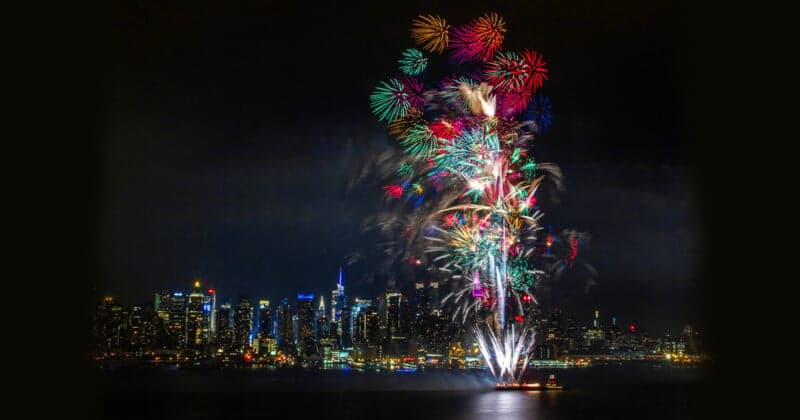
Once the first shells go up, the display turns into a moving target, with smoke thickening, light changing by the second, and the cleanest moment disappearing almost as fast as it arrives. A fireworks night rewards more than the usual tripod-and-bulb routine.
Millions of families gather for fireworks, and the U.S. Consumer Product Safety Commission counted at least 15 fireworks-related deaths and an estimated 13,000 emergency department-treated injuries in 2025, including about 1,300 injuries from sparklers. The National Fire Protection Association estimated fireworks started 34,079 fires in 2024 and caused an estimated $98 million in direct property damage, while OSHA treats fireworks displays as pyrotechnic-hazard work. If you are carrying a camera into that scene, treat the show as a changing field of light, smoke and timing, not a single exposure problem.
Set the camera in manual before the first shell
Manual mode is the anchor for everything here. Fireworks do not stay at one brightness for long, and automatic exposure tends to chase the light in a way that flattens the burst or blows out the core. Start in manual, then use aperture and ISO as your control points, because the best frame is usually the one where you decide how much detail to keep, not the camera.
Keep an eye on the sky brightness, the smoke, and the ambient glow from the crowd or nearby buildings. If the display is bright, narrow the aperture a bit and keep ISO low enough to preserve color in the highlights. If the show is dimmer or the bursts are smaller, lift ISO before you let the shutter drag so long that the frame turns muddy.
Streaks: let the burst draw its own line
For streaks, think in terms of motion, not stillness. Open the shutter as the shell climbs or as the burst starts to expand, then close it once the arc has drawn enough of its shape to read as a trail. A longer exposure is what gives you those glowing lines, but the point is control: you want the shell to paint, not wash the whole frame into brightness.
This is where a tripod earns its keep, because even a slight wobble can turn the trail into a blur that looks accidental instead of elegant. The common failure point is timing too late, after the burst has already peaked and begun to fade. The other trap is overexposure, which wipes out the trail structure and leaves you with a white fireball instead of a clean line of motion.
Silhouettes: use the crowd, trees or skyline as shape
Fireworks look richer when something is in front of them. A spectator raising a phone, a tree line, a roofline or a railing gives the burst a sense of scale and turns the frame into a scene rather than a postcard. Expose for the fireworks and let the foreground go dark, which gives you a silhouette with hard edges and an immediate sense of place.
The timing matters here because silhouettes work best before the sky goes completely black and before the crowd dissolves into a single mass. Place your subject where the fireworks will land behind it, then wait for a burst that opens above the outline cleanly. The usual mistake is trying to light the foreground too much, which drains the silhouette of its shape and makes the fireworks feel pasted on instead of part of the same scene.
Crowd context: widen out before you zoom in
A fireworks show is also a public gathering, and the crowd can carry as much story as the burst itself. Pull back enough to include people, reflections, the fairground glow or the city skyline, and you get the scale of the event instead of just the pattern in the sky. That wider framing is strongest in the blue-hour stretch, when the crowd still reads as a crowd and the first bursts have enough contrast to stand off the background.
This look fails when you crop so tight that the frame loses all sense of place. It also fails if you wait until the sky is fully black and the surrounding scene disappears into a featureless void. If you want context, shoot early in the show and use the in-between moments, not just the biggest detonations.
Zoom effects: move the lens while the shutter stays open
Zoom effects work because they turn a burst into a radial pattern instead of a static object. Set the exposure long enough to keep the shutter open through the burst, then zoom smoothly during the exposure so the fireworks stretch outward or collapse inward. A clean, deliberate move is better than a frantic one, because the point is to make the frame feel energized, not chaotic.
Manual focus helps here because autofocus can hunt while the lens is moving and ruin the shot. The other common failure point is overdoing the zoom range, which turns a vivid shell into a smeared blob with no center. Use a burst with a strong core and a clear color edge, then let one smooth zoom motion carry the effect.
Abstract blur: shift focus on purpose
Abstract blur is where fireworks stop being documentation and start becoming interpretation. Instead of trying to keep every spark sharp, change focus during the exposure or deliberately defocus partway through the shot so the burst layers into painterly bands of color. That controlled softness can make a familiar display look dreamlike, especially when several shells overlap.
The trick is to commit to the blur instead of half-trying for sharpness and half-trying for abstraction. If you move focus too early, the frame can collapse into a gray fog with no structure left in it. If you move too late, the effect looks like a mistake instead of a choice, so keep the motion intentional and repeat it until the blur has a shape you like.
Save the finale for a sequence, not a single frame
The last barrage is usually the most tempting and the easiest to ruin. Smoke builds fast, and by the grand finale the cleanest burst may be hidden behind a haze that turns color into milk. A better move is to shoot a short sequence of frames through the finale and keep the clearest ones, which gives you a better chance of finding a burst before the smoke wins.
If the smoke starts swallowing the frame, stop waiting for the mythical hero shot and work the sequence instead.
This article was produced by Prism’s automated news system from verified source data, official records, and press releases, then run through automated quality and moderation checks before publishing. The system is built and supervised by the people who set the standards it runs under. Read our full AI policy.
Did this article answer your question?