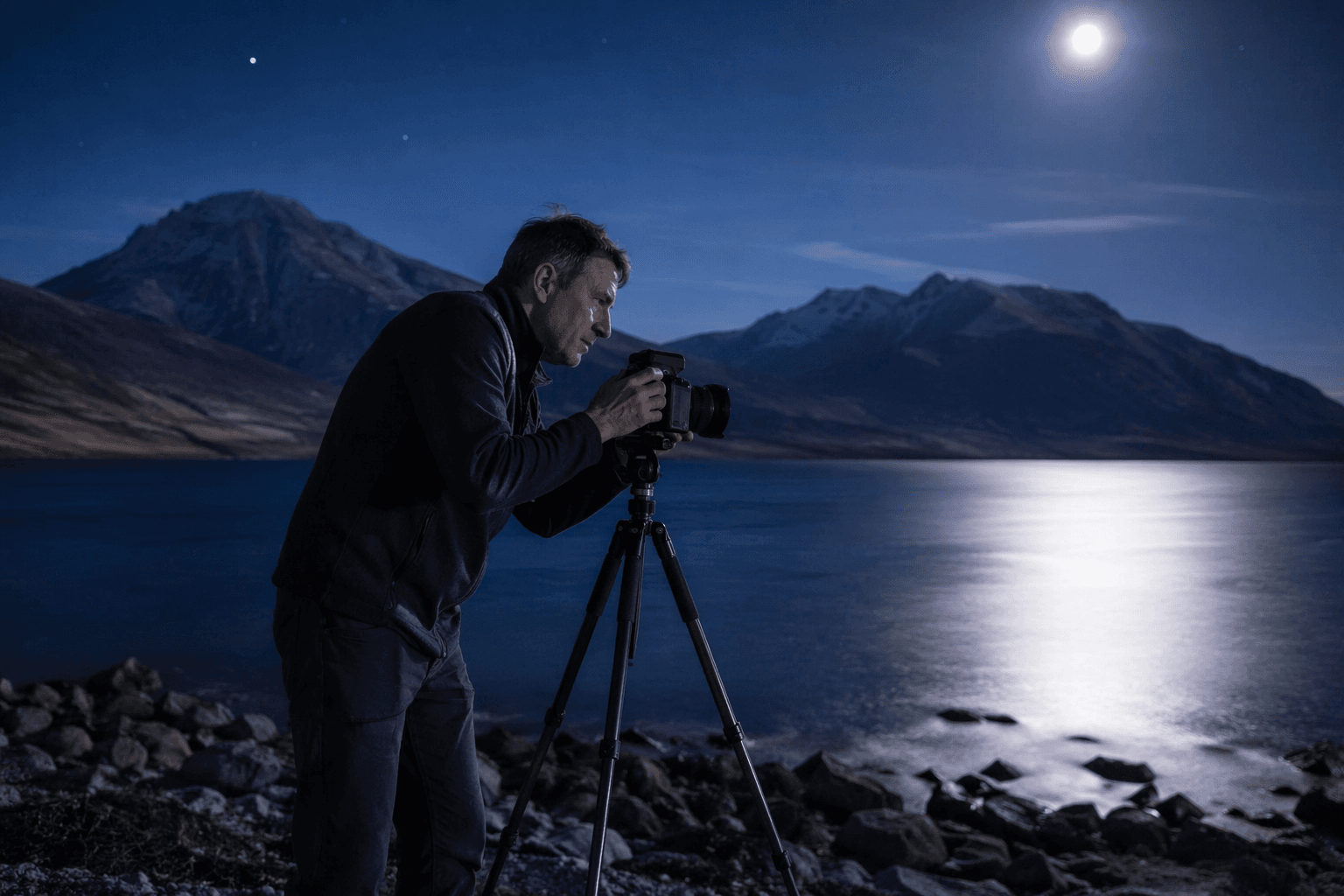
Darren Almond’s Fullmoon series makes moonlit terrain look almost overcast, but the real lesson is technical: long exposure can pull color and tone out of darkness when the eye sees very little. That shift from night vision to luminous landscape is what gives the work its punch, and it is also why the series still matters to anyone trying to photograph moonlight with control instead of guesswork.
Moonlight, not magic
Almond’s method starts with a simple fact that changes everything in the field: moonlight is reflected sunlight. Give the sensor or film enough time, and it can gather enough photons to record tonal range and color that do not register in the moment. In Fullmoon, that principle turns Yosemite Valley, Patagonian ice, Japanese temple gardens and Bermuda’s pink sand into scenes that can read like daylight, even though they were made in moonlit darkness.
That is why the series feels so instructive for night work. The effect is not built on exotic gear or a trick preset, but on patience, planning and a willingness to let the exposure run long enough to do the heavy lifting. The result is a body of work that shows how familiar places can become strange again when you stop trying to freeze the night and start letting it accumulate.
A project that spans decades and continents
The expanded TASCHEN edition of Fullmoon gathers more than 370 images and traces the project from the turn of the century to the present. It widens the geography beyond the best-known examples, bringing in landscapes from Yosemite, the Japanese seashore, Patagonia, Bermuda, the Alps and the English meadows. Sheena Wagstaff writes the introduction, and Brian Dillon contributes an essay, giving the book both curatorial context and interpretive frame.
Tate identifies Darren Almond as born in 1971, and that matters because his moonlit work sits firmly inside contemporary photographic practice rather than outside it as a one-off experiment. The series has become a long-running study in how repeated technique can produce a recognisable visual language. The locations change from continent to continent, but the underlying method stays consistent enough to teach.
The 15-minute image that explains the whole series
The clearest technical benchmark in the whole project is Fifteen Minute Moon. The Metropolitan Museum of Art describes the image as a dramatic expansion of the film’s exposure from a fraction of a second to fifteen minutes, and notes that the glowing river in the picture is actually the trace of car headlights on a highway. That detail matters because it shows how long exposure does not just reveal what is there, it also records movement as part of the composition.
This is the point where Fullmoon becomes more than a mood piece. A 15-minute exposure can transform headlights into a luminous river, or let a landscape gather enough light to read with a softness close to daylight. Ocula places the series’ exposures between 12 and 30 minutes, which gives a practical range for anyone thinking about how long moonlight needs to build a believable tonal field.
What to copy from Almond’s workflow
The project’s discipline is as important as its duration. Almond works around the full moon, watches cloud forecasts obsessively and accepts that one stray headlight or a drifting cloud can ruin a 15-minute exposure. That is the sort of constraint that turns moon photography from casual night shooting into careful fieldcraft, because the exposure is only one part of the equation.
A few practical lessons stand out:
- Treat the full moon as your light source, not a background detail. Almond’s images depend on that phase because it gives the scene enough reflected light to build tone over time.
- Build in time for weather, because cloud cover can make or break the frame. In this kind of work, a forecast is as important as the location.
- Protect the scene from motion you did not plan, especially headlights and passing traffic. Fifteen minutes is long enough for small interruptions to become part of the picture.
- Expect exposures measured in minutes, not seconds. The Ocula figure of 12 to 30 minutes is a useful reference point for how far beyond conventional night shooting this method goes.
Those choices explain why Fullmoon has such staying power with photographers. It shows that the difference between a black frame and a glowing landscape is often not a brighter lens or a new camera body, but a deeper understanding of exposure, timing and place. Almond’s early experiment in Fifteen Minute Moon, whether you place the start of the series in 1998 or 1999, set the pattern for the entire body of work: moonlight can be made to look like daylight if you give it enough time.
That is the enduring trick of Fullmoon. The images begin in darkness, but they are built slowly enough to let the moon do the work, and once you see that, a 15-minute exposure stops looking extreme and starts looking like the clearest way to photograph night.
Every story on Photography News is assembled by an automated editorial system that works from verified research, official records, and credible reporting, then clears automated accuracy and moderation checks before it goes live. The standards that system follows are set and overseen by the people who run the publication. Read our full editorial policy.
Did this article answer your question?