James Webb image reveals a galaxy cluster still merging in Columba
Webb’s Columba cluster image shows two equal-mass subclusters already past each other and still more than a million light-years apart.
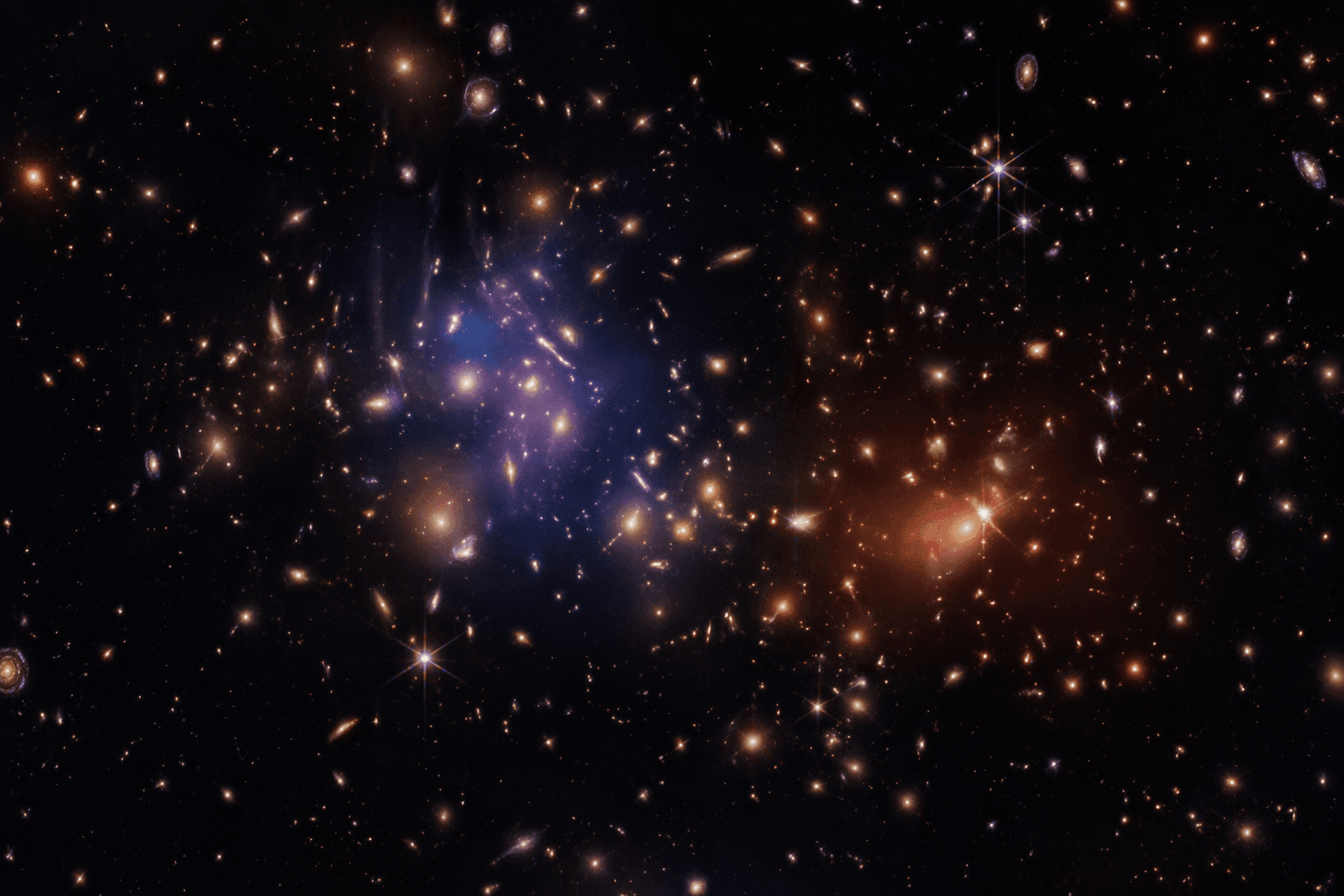
ESA released a Webb image of MACS J0553.4-3342 on July 3 as its Picture of the Month, and the frame catches a galaxy cluster in Columba mid-merger instead of fully formed. The system sits at redshift 0.412, which ESA says means we see it as it was 4.4 billion years ago.
That is the hook for anyone who cares about astronomical imaging: the photograph does not freeze a finished object, it catches a structure still under construction. ESA says MACS J0553.4-3342 is made of two sub-clusters of roughly equal mass that have already passed through each other and are now more than one million light-years apart, but will eventually fall back together and merge into one system.
The picture works because it gives the eye enough scaffolding to read the scale. Webb’s Near-Infrared Camera, used for the VENUS survey programme, separates the cluster core from the busy field behind it, and the result is a frame packed with thousands of background galaxies. Many of those distant objects are stretched and reddened by the expansion of the universe, so the image does not just show a cluster, it layers foreground mass, lensed background light, and deep-time structure into one view.
The strongest visual cue is the lensing. ESA says the cluster acts as a gravitational lens, producing orange, elongated arcs around the two subclusters, and one arc on the left is actually three images of the same background galaxy. That kind of repetition is exactly what makes Webb images so compelling to photographically minded readers: the scene is beautiful, but it is also legible, with distortion itself becoming the proof of the physics at work.
The older X-ray work on MACS J0553.4-3342 makes the new frame even more interesting. A 2017 Monthly Notices of the Royal Astronomical Society paper described the cluster as a young merging system and one of the hottest and most luminous known, with an average intracluster-medium temperature of 12.1 ± 0.6 keV. It also reported the two subclusters were separated by about 650 kpc, traced a tail-like X-ray structure extending about 1 Mpc from the eastern subcluster, and identified a merger-driven cold front and a likely shock front.
Put the two views together and the Webb image stops being just another pretty deep-field poster. It becomes a photograph of change in progress, with NIRCam turning invisible structure into something the eye can follow: two cluster cores, a crowded field of background galaxies, and lensing arcs that make the whole system feel both immediate and impossibly old.
This article was produced by Prism’s automated news system from verified source data, official records, and press releases, then run through automated quality and moderation checks before publishing. The system is built and supervised by the people who set the standards it runs under. Read our full AI policy.
Did this article answer your question?