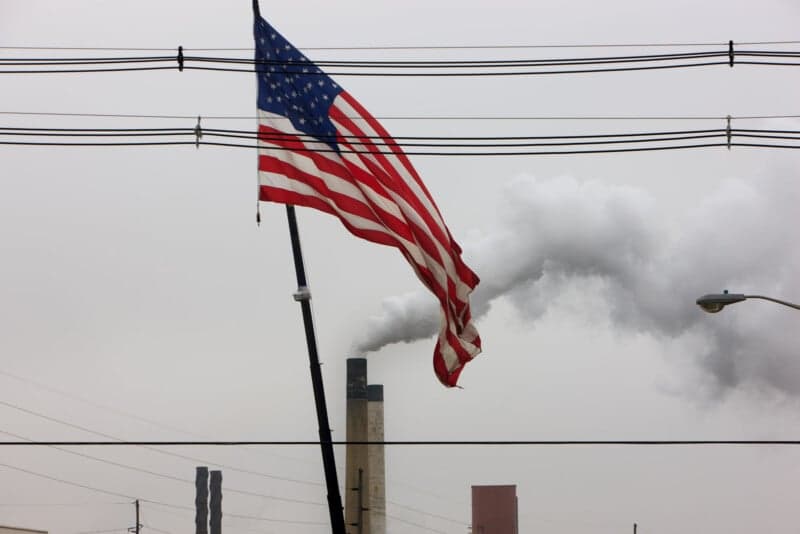
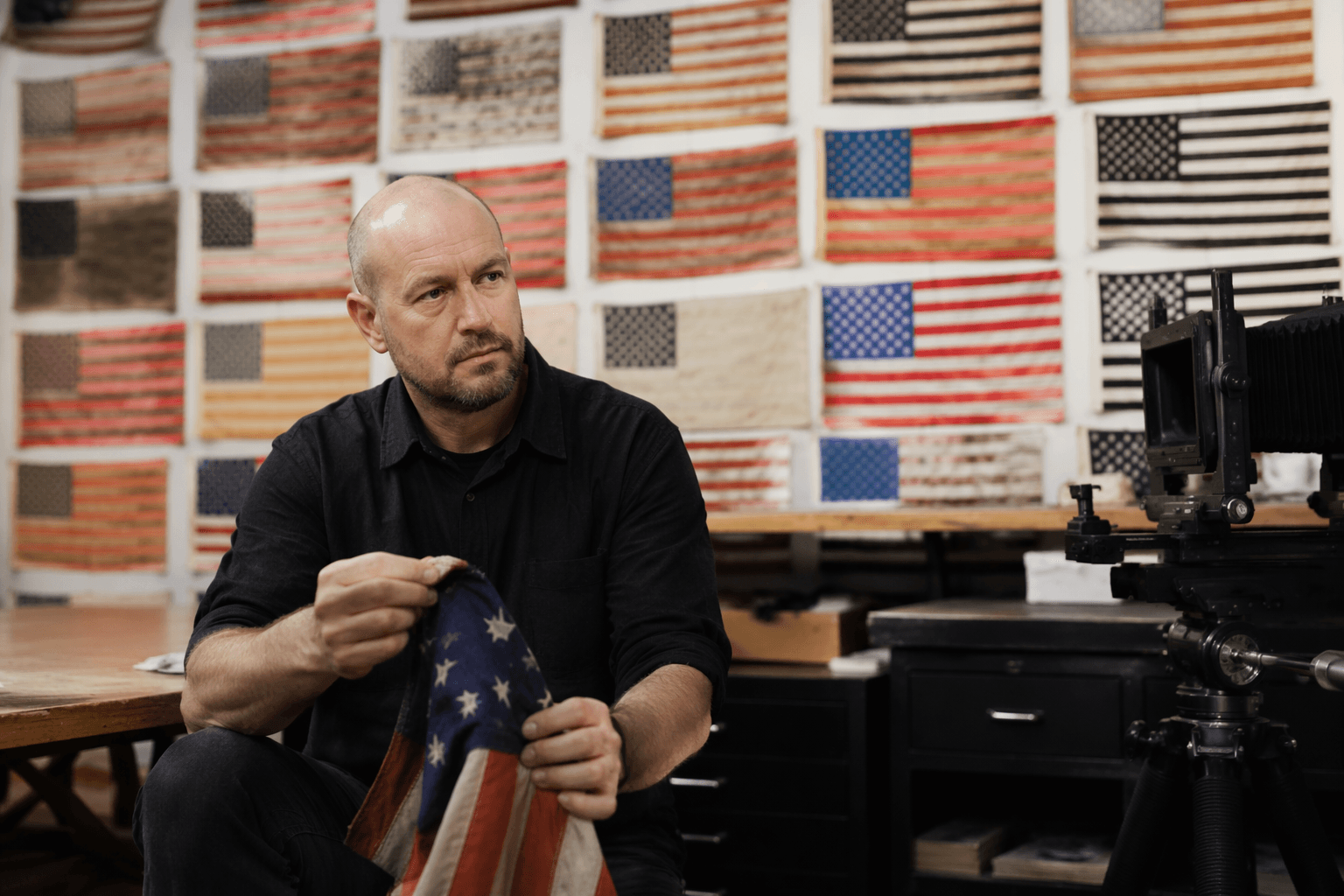
Jason Lindsey has turned one of photography’s most familiar subjects into something slower, stranger, and more revealing. Over about 15 years, he photographed American flags across the United States, then shaped that archive into UNFINISHED, a four-minute film built entirely from still images for America’s 250th anniversary. The result is less about national spectacle than about seeing how a symbol changes when it is left in the wild.
A long project built from ordinary repeats
Lindsey’s project works because it starts with a subject that seems almost too common to matter. Flags appear on barns, storefronts, doors, lots, roadside structures, and in commercial graphics, but the series shows that repetition is not a weakness when the eye stays sharp long enough. The best images in the project are not the ones that look most ceremonially patriotic; they are the weathered, improvised, and embedded versions that blend into daily life.
That shift from casual noticing to deliberate hunting is the real backbone of the work. Lindsey did not begin with a fixed thesis and then go out to illustrate it. He started by capturing flags almost as a travel habit, then gradually learned to seek them out with more intention. For photographers, that is the practical lesson: a project can begin as a reflex, then gain structure only after years of paying attention to what keeps resurfacing.
Why the flag keeps changing meaning
Lindsey’s own framing gives the project its tension. On his website, he describes the flag as something that means different things depending on the street or setting, and says that contradiction became the work. In one place it can read as pride, in another as nostalgia, struggle, or political tension. The same cloth behaves differently when it is hand-painted on a barn, taped in a storefront window, flown in perfect condition, or left shredding in the wind.
That ambiguity is what keeps UNFINISHED from becoming a simple patriotic portfolio. The official film page says the project is meant to witness the distance between what America promises and how people actually live, with no faces and no narration about who is right. The Vimeo presentation distills it even further: the flag is a promise, the photograph is evidence, and the film is the space between them. That line captures why the work feels less like an argument than a visual record of competing meanings.
From still archive to four-minute film
The move from a long-running photo series to a four-minute film matters because it shows how editing can give a subject new shape. According to PetaPixel, Lindsey wanted the final film to stay politically neutral, and that took multiple script drafts before he found the right tone. That kind of revision is familiar to anyone who has tried to assemble a coherent project from years of scattered frames: the challenge is not finding images, but finding the structure that lets them speak together.
UNFINISHED uses still photographs only, which is important to the way it feels. There are no talking heads and no explanatory narration to settle the meaning in advance. Instead, the photographs carry the burden of evidence, and the sequencing does the interpretive work. For a long-term photographer, that is a powerful reminder that a body of work does not need motion, dialogue, or spectacle to feel complete.
A project shaped by the semiquincentennial
The timing gives the film a larger civic frame. America250 says the U.S. Semiquincentennial Commission was established by Congress in 2016 to plan and orchestrate the 250th anniversary of the signing of the Declaration of Independence, and the observance is centered on July 4, 2026. The Library of Congress says the anniversary is being marked through national, state, and local initiatives, which places Lindsey’s film inside a broader wave of public reflection.
That context matters because it keeps the project from floating free as a private art exercise. It is tied to a moment when the country is actively revisiting its own image, and Lindsey’s flags sit right inside that conversation. The project does not answer what America is. It shows how the symbol appears when people actually live with it.
The flag’s history deepens the reading
The series also sits on top of a long visual history. The original Flag Resolution of June 14, 1777 established 13 stripes and 13 stars. The current 50-star flag dates from July 4, 1960, after Hawaii became the 50th state. Those changes remind you that the flag has never been static, even when people treat it as fixed.
That history makes Lindsey’s photographs feel less like isolated observations and more like part of a longer civic archive. The flag in his frames is not a single frozen icon. It is a national marker that has been revised by Congress, absorbed into everyday life, and reused in ways that range from formal display to improvised decoration. The symbol carries its official history, but the photographs are interested in how that history looks when it collides with ordinary American spaces.
What the project offers your own work
The strength of UNFINISHED is not that it found a rare subject. It is that it stayed with a simple one long enough for variation to emerge. The series shows how geographic range, repetition, and changing intent can turn a motif into a body of work with real staying power. A photograph becomes more than a single frame when it can sit beside dozens of others and still reveal new differences.
That is the practical blueprint Lindsey leaves behind. Keep the subject close. Move across enough places that the repetitions start to diverge. Pay attention to weather, condition, placement, and use, because those details shift the meaning of even the most familiar object. In Lindsey’s hands, the flag is not just a national emblem. It is a test of how long a photographer can look before a symbol starts to speak back.
Every story on Photography News is assembled by an automated editorial system that works from verified research, official records, and credible reporting, then clears automated accuracy and moderation checks before it goes live. The standards that system follows are set and overseen by the people who run the publication. Read our full editorial policy.
Did this article answer your question?