Kodak PIXPRO C1 embraces simple, creative shooting for hobby photographers
The PIXPRO C1 strips photography back to a pocketable fixed-lens compact, and that simplicity may be the whole appeal for some shooters.
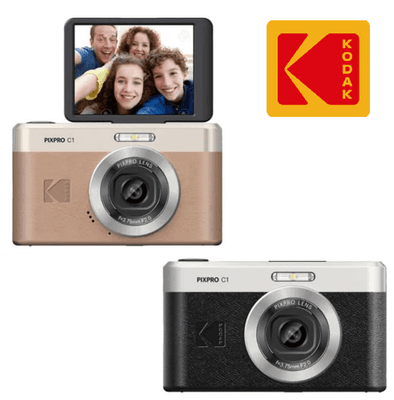
Kodak’s PIXPRO C1 lands in the middle of a camera market obsessed with bigger sensors, more modes, and more menus, yet its pitch goes the other way entirely. This is a small, all-plastic fixed-lens camera that asks you to point, frame, and keep moving, then dresses that simplicity in a deliberately playful package. For some photographers, that is the point: a camera that gets out of the way can feel more creative than one that keeps demanding attention.
A compact that chooses a mood
Kodak PIXPRO positions the C1 as part of its Friendly Zoom line, and the official language leans hard into the idea of a vintage-style camera for trendsetters. The tone matters because this is not being sold as a miniature powerhouse; it is being sold as a camera with a point of view. The U.S. MSRP is listed at $119.99 on the official product page, while Best Buy has carried the black DSC-C1-BK-US-1 at $99.99, which puts it squarely in impulse-buy compact territory.
That price band helps explain the conversation around it. Amateur Photographer places the C1 inside the current retro-compact wave, where portability and nostalgia count almost as much as raw performance. That is the same broad appeal behind film revival, only translated into digital: people want a camera that feels light, physical, and uncomplicated enough to take everywhere.
What the C1 actually gives you
Under the nostalgic styling, the C1 is straightforward. The Japanese specification page lists a 13MP CMOS sensor, a 26mm f/2.0 lens, 1080p video at 60 fps or 30 fps, 4x digital zoom, a 180-degree tilt LCD, and support for microSD and microSDHC cards up to 32GB. B&H’s listing adds that the sensor is a 1/3-inch BSI CMOS unit, which is a reminder that this camera is built for compactness first.
DIY Photography’s breakdown fills in the shooting experience in more tactile terms. It describes the C1 as pocketable, with a fixed 5-element 3.57mm f/2 lens that gives an approximate 26mm full-frame equivalent field of view, autofocus from roughly 60cm to infinity, an 8cm macro option, an internal flash, and a flip-up LCD that can tilt for waist-level framing or selfies. It also points to the camera’s creative effects, including vivid, colored pencil, sketch, negative, and partial-color looks.
That mix is revealing. The C1 is not trying to win on flexibility, it is trying to make a narrow set of choices feel fun. The shooting recipe is simple enough to fit in your head quickly, and for a lot of hobby photographers that is a feature rather than a compromise.
Why simple can feel creative
There is a real audience for a camera that behaves less like a tiny computer and more like a direct visual instrument. If you like wandering with a camera in a jacket pocket, making quick frames of street details, café scenes, notebooks, signage, or friends, the C1’s low-friction approach makes sense. The 180-degree tilting screen also opens the door to casual self-portraits, waist-level compositions, and creator-style clips without turning the camera into a menu project.

The built-in effects matter here too. Colored pencil, sketch, negative, and partial-color looks are not subtle tools for lab-grade control, but they give the camera a recognizable aesthetic from the moment you pick it up. That kind of opinionated processing appeals to photographers who want a finished look fast, especially if they are chasing a lo-fi digital feel without dragging images through software afterward.
The C1 also fits a kind of shooting that lives between phone snaps and serious system-camera work. It is the sort of compact you keep close for errands, short trips, and casual experiments, not because it can do everything, but because it makes one mode of seeing feel easy. That ease is what gives low-cost fixed-lens cameras a second life in a market that otherwise keeps nudging people toward expensive bodies and lens ecosystems.
The limits show up quickly
The same constraints that make the C1 charming will also define its ceiling. A 26mm-equivalent lens and 4x digital zoom will not turn it into a wildlife tool, a sports camera, or a long-reach event machine. The autofocus range from roughly 60cm to infinity, plus the modest macro option, tells you exactly where it wants to live: close, casual, and spontaneous.
Its battery and storage choices reinforce that positioning. The built-in 3.7V 700mAh lithium-ion battery charges over USB-C, with the Japanese specification page listing an approximate 2.5-hour charge time, and the camera uses microSD or microSDHC cards up to 32GB. The shutter range, from 1/10000 to 2 seconds, is useful for a compact, but it does not change the fact that this is a camera built for accessible, everyday shooting rather than demanding control.
That is why some photographers will outgrow it fast. If you want RAW files, deeper manual handling, interchangeable lenses, or a body that can stretch from fast action to distant subjects, the C1 is going to feel limiting almost immediately. Its job is not to replace a serious mirrorless setup. Its job is to make making pictures feel lighter again.
A pocket camera for people who want less friction
The C1 works best for beginners who want a real camera without a steep learning curve, for hobbyists who like retro styling and simple controls, and for artists who enjoy camera-made effects as part of the image itself. It is also a neat fit for anyone who misses the feeling of carrying a small compact everywhere and wants something more deliberate than a phone, but less demanding than a full system body.
That is the countertrend at the heart of the PIXPRO C1. In a spec-heavy era, it offers a narrower path on purpose, and that narrowness is what makes it interesting. For the right shooter, the appeal is not that it can do everything, but that it makes it easier to start making pictures the second it leaves the pocket.
This article was produced by Prism’s automated news system from verified source data, official records, and press releases, then run through automated quality and moderation checks before publishing. The system is built and supervised by the people who set the standards it runs under. Read our full AI policy.
Did this article answer your question?