Rediscovered Maine fishing archive becomes a vivid coastal photobook
Jeff Dworsky’s fishing pictures feel like family history and sea lore at once. The rediscovered archive turns a 40-year life on a small Maine island into a photobook that behaves like a legend.
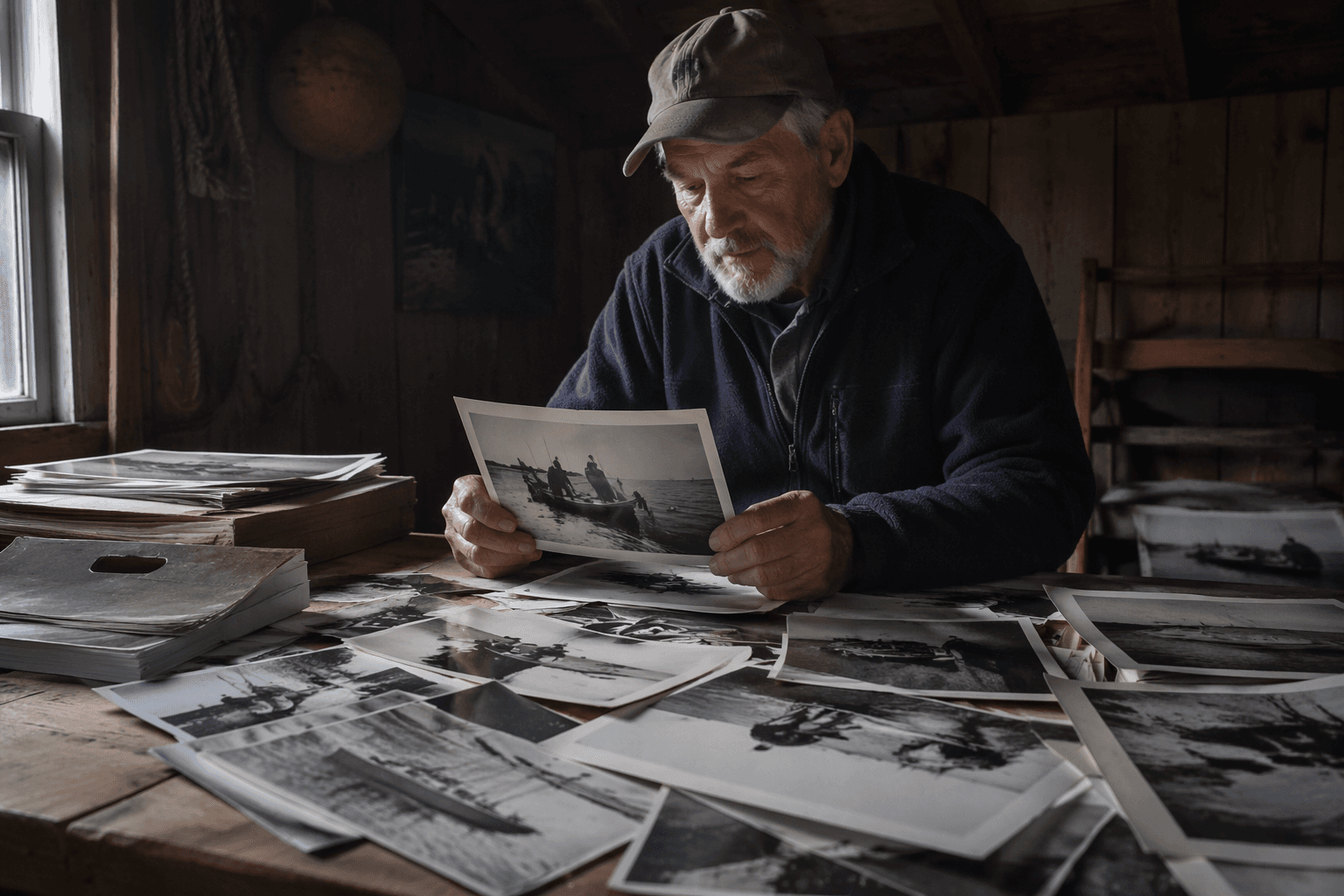
Jeff Dworsky did not come to Maine as an observer. He dropped out of school at 14, bought a Leica at 15, and by 16 had moved to a small island in Maine to become a fisherman, then settled in Stonington from Massachusetts in 1973 at 17. That matters because the pictures in *Sealskin* are not souvenirs from a visiting camera bag. They are the working record of someone who stayed, fished for 40 years, raised children there, and is still on a small island in Penobscot Bay.
The result is a body of work that feels both documentary and inherited, as if it had been passed down rather than made. Dworsky has said he wanted to document the changing world around him before it disappeared, and the images carry that urgency without turning into nostalgia. They show coastal life from the inside, where weather, work, family, and routine are all part of the same visual grammar.
Why the archive feels bigger than its size
Dworsky photographed that life with a Leica and Kodachrome film, a combination that gives the archive its crisp but haunted color. The camera’s precision locks in the details of ropes, docks, faces, and fog, while Kodachrome lends the pictures a glow that keeps them from reading like plain record-keeping. That tension is what gives the work its charge: the scenes are unmistakably real, but they arrive with the density of folklore.
The photographs focus on his wife, his children, fishing, and the quiet rituals of domestic and maritime labor. There is no attempt to explain the community into neatness. Instead, the archive builds meaning through repetition, proximity, and the slow accumulation of lived detail, the way a village actually teaches you its shape.
How the book was found
The path from private archive to photobook began with Jesse Lenz, who encountered Dworsky about ten years before publication in a small coffee shop on an island in Penobscot Bay, Maine. Charcoal Press says Lenz was wearing a Leica around his neck when Dworsky started the conversation, a detail that sounds almost scripted until you remember how often photography careers hinge on small recognitions. A camera on a chest, a sentence exchanged over coffee, and an archive that had sat quietly for decades suddenly had a public future.
Lenz has described Dworsky as his ideal of an artist, someone obsessed with living his life and making pictures as a byproduct. That frame helps explain why the photographs do not feel overdesigned. They were not built to illustrate a thesis first and a life second. The life came first, and the images grew from it.
Sealskin and the pull of selkie folklore
*Sealskin* takes its title and its emotional structure from selkie folklore, the Celtic body of stories about beings that move between seal and human form. A 2024 review of the book describes it around an old Celtic folktale in which a fisherman marries a seal-woman, has children with her, and eventually loses her to the sea. That mythic pattern fits Dworsky’s pictures because they are full of thresholds: land and water, work and home, intimacy and distance, belonging and departure.
Lenz has said the folktale resonated because folklore and myths may be more real than people think. In this book, that is not a decorative idea. It is the structure that lets the pictures breathe as both evidence and legend. The shoreline becomes less a backdrop than a border where human life is always in negotiation with something older and larger.
The physical book matches the heft of the archive
Charcoal Press lists *Sealskin* as a 110-page, 10 x 13-inch hardback, which gives the project the scale it deserves. This is not a slim, disposable object, and the format matters for work built from atmosphere, weather, and texture. The larger page size suits the fog-bound images and the domestic scenes alike, letting the book move between portrait, place, and ritual without crowding the photographs.
The book is now in a second printing after the first edition sold out, which tells you something useful about appetite for long-view, place-based photography. A project rooted in one island and one fishing life still found enough resonance to move from rediscovery to demand. That is often the quiet test for archival work: whether the personal history can hold a reader who was never there.
What Dworsky’s pictures teach photographers
Dworsky’s archive offers a practical lesson in how atmosphere gets built. It does not come from over-explaining the subject or chasing a gimmick. It comes from staying with one place long enough that the camera starts to collect relationships instead of isolated scenes.
A few things stand out clearly from *Sealskin*:
- Use the tools that fit the life you are actually living. Dworsky’s Leica and Kodachrome were part of the same world as the fishing.
- Let family and work share the frame. His wife, children, and labor are not separate subjects.
- Trust repetition. The power comes from the accumulation of ordinary moments over decades.
- Leave room for myth without forcing it. The selkie reading works because the pictures already carry that mood.
- Think of a camera as a lifelong notebook. The archive matters because it was made across time, not during a brief project sprint.
That is why the work feels so durable. It is rooted in Stonington and Penobscot Bay, but it keeps opening outward, into memory, folklore, and the larger question of what disappears when a way of life changes shape.
A village preserved without being frozen
The strongest thing about *Sealskin* is that it never turns Maine into a postcard version of itself. It captures a fishing community in a small Maine village during the 1970s and 1980s, but it does so with enough intimacy to resist museum language. The photographs remember a world in motion, one where family, labor, and weather were never really separate.
That is the book’s lasting tension: it is a record of something real, but it behaves like a coastal legend because Dworsky lived close enough to the work for the images to inherit its mystery.
This article was produced by Prism’s automated news system from verified source data, official records, and press releases, then run through automated quality and moderation checks before publishing. The system is built and supervised by the people who set the standards it runs under. Read our full AI policy.
Did this article answer your question?